Paging
Introduction
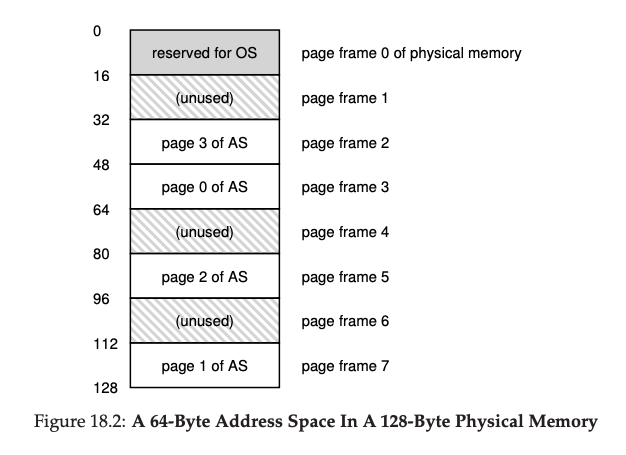
Instead of splitting up a process's address space into some number of variable-sized logical segments (e.g., code, heap, stack), we divide it into fixed-sized units, each of which we call a page.
- Page: a fixed-size chunk of virtual address space (commonly 4 KB)
- Page frame: a fixed-size slot in physical memory that holds one page
Memory
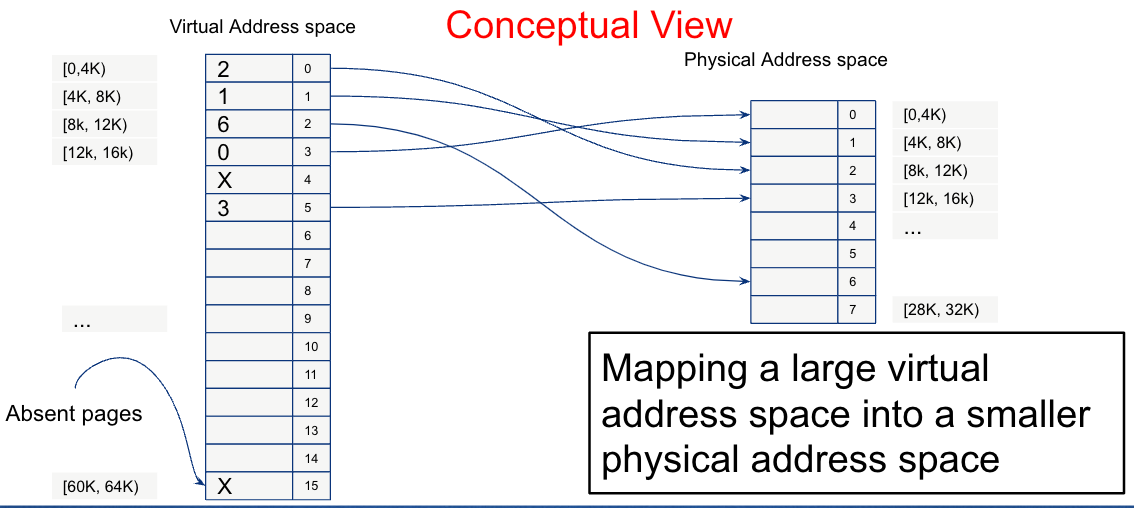
Page Table
To record where each virtual page of the address space is placed in physical memory, the operating system usually keeps a per-process data structure known as a page table. Each entry in the page table is called a Page Table Entry (PTE) and contains:
- The physical frame number
- A valid bit (is this page part of the address space at all?)
- A present bit (is this page currently in physical memory, or swapped out to disk?)
- Protection bits (readable? writable? executable?)
- A dirty bit (has the page been written since it was loaded?)
- A reference bit (has the page been accessed recently?)
If a process touches a page whose valid bit is 0, the OS treats it as an illegal access and kills the process (a segmentation fault on Linux). If the page is valid but its present bit is 0, the OS brings the page in from disk (see Swapping below).
Virtual Address
A virtual address is split into two parts:
- VPN (Virtual Page Number): index into the page table
- Offset: byte position within the page (same in virtual and physical)
Address Translation
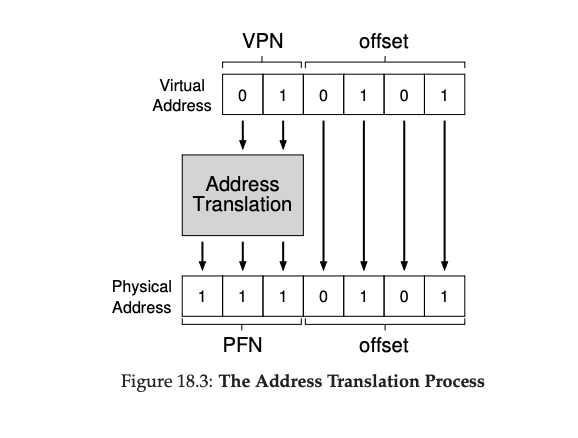
On every memory access the hardware Memory Management Unit (MMU) performs: physical_address = page_table[VPN].pfn * page_size + offset
The Translation Lookaside Buffer (TLB)
Paging introduces a problem: every memory access now requires two memory accesses, one to look up the page table and one to fetch the actual data. This would halve memory performance.
The solution is a TLB (Translation Lookaside Buffer): a small, fast hardware cache (often fully associative) of recent VPN→PFN translations, located inside the MMU.
TLB hit (common case): the VPN is in the TLB → translation costs zero extra memory accesses.
TLB miss (rare): the VPN is not cached → the hardware (or OS, on software-managed TLBs like MIPS) walks the page table, loads the translation into the TLB, and retries. This is expensive.
TLBs work because programs exhibit locality:
- Temporal locality: recently accessed pages are likely to be accessed again
- Spatial locality: pages near recently accessed pages are likely to be accessed soon
A 64-entry TLB with 4 KB pages covers 256 KB of address space, which is enough to capture most of a program's working set.
Context switch cost: TLB entries are process-specific. On a context switch the OS must either flush the TLB (expensive) or tag each entry with an ASID (Address Space Identifier) so entries from different processes can coexist.
Multi-Level Page Tables
A flat page table for a 64-bit address space would be enormous: with 4 KB pages and 8-byte entries it needs 2^52 entries (32 PiB per process), and even x86-64's 48-bit space would need 512 GiB. Modern systems use multi-level page tables to keep page tables sparse.
The virtual address is split into multiple VPN fields, each indexing a different level of a tree:
VPN[0]  VPN[1]  Offset
  │        │       │
  ▼        ▼       ▼
Level-1  Level-2  Physical
 Table    Table    Page
Only the portions of the address space that are actually in use need page table memory. A process that uses only a small fraction of a 64-bit address space has a small page table. x86-64 uses a 4-level page table (5 levels on recent CPUs); ARM64 uses up to 4 levels with 4 KB pages.
Page Replacement Algorithms
When physical memory is full and a new page must be brought in, the OS must evict an existing page. Which one to pick?
Optimal (OPT / MIN)
Evict the page that will be used furthest in the future. Provably optimal, but impossible to implement (requires knowing the future). Used as a benchmark to evaluate real algorithms.
FIFO (First In, First Out)
Evict the page that has been in memory the longest. Simple but poor: evicts frequently used pages if they were loaded first. Suffers from Belady's anomaly: adding more physical frames can increase faults.
LRU (Least Recently Used)
Evict the page that was used least recently. Works well in practice because of temporal locality. True LRU is expensive (requires tracking access time for every page), so real systems approximate it.
Clock Algorithm (Approximation of LRU)
Uses the reference bit in each PTE. A clock hand sweeps through page frames in a circle:
- If the reference bit is 1, clear it and advance.
- If the reference bit is 0, evict this page.
The OS clears bits as it sweeps; the hardware sets a page's bit again if it is used before the hand comes back around. This gives a good LRU approximation at low cost per eviction. Linux uses a variant of this called the active/inactive list approach.
Swapping
When a process accesses a valid page with the present bit set to 0 (not in physical memory), the CPU raises a page fault. The OS page fault handler:
- Finds the page on disk (in the swap area)
- Reads it into a free physical frame (evicting another page if necessary)
- Updates the PTE and sets the present bit
- Restarts the faulting instruction
From the process's perspective, the address space appears larger than physical RAM: this is the illusion of virtual memory.