Process API
Introduction
- fork()
- wait()
- exec()
- kill()
- pipe()
Fork 🍴
- creates a child process that is a clone of the parent
- The child is a near-exact copy of the parent. The main differences are its process id, its parent process id, and the value fork() returns (see
man 2 forkfor the full list) - fork() is called once but it returns twice!
Process Hierarchy
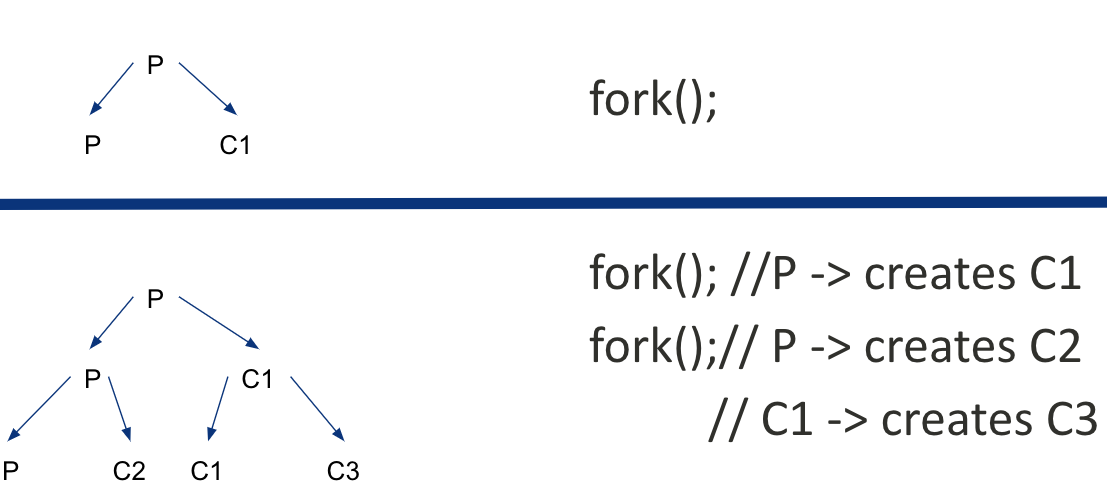
Exercise
On success, the PID of the child process is returned in the parent, and 0 is returned in the child. On failure, -1 is returned in the parent, no child process is created, and errno is set to indicate the error.
/* process A */
/* ... */
if ( fork () == 0) {
   if ( fork () == 0) {
       if ( fork () == 0) {
           if ( fork () == 0) {
               /* do something */
           }
       }
   }
}
How many new processes are created by the code snippet?
Wait 🚏
Sometimes, as it turns out, it is quite useful for a parent to wait for a child process to finish what it has been doing. This task is accomplished with the wait() system call (or its more complete sibling waitpid()).
Exec
A final and important piece of the process creation API is the exec() system call. This system call is useful when you want to run a program that is different from the calling program
Linux vs Windows
| Linux | Win32 |
|---|---|
| fork(), exec() | CreateProcess() (fork exec combined) |
| exit() | ExitProcess() |
| wait(), waitpid() | WaitForSingleObject(), WaitForMultipleObjects() |
| kill() | TerminateProcess() |
Signals
Linux/Unix signals are a type of event. Signals are asynchronous in nature and are used to inform processes of certain events happening (man 7 signal).
Common Signals
| Signal | Default Action | Description |
|---|---|---|
SIGINT | Terminate | Interrupt from keyboard (Ctrl+C) |
SIGTERM | Terminate | Termination request (default signal from kill) |
SIGKILL | Terminate | Forceful termination; cannot be caught or ignored |
SIGCONT | Continue | Resume a stopped process |
SIGSTOP | Stop | Pause process; cannot be caught or ignored |
SIGSEGV | Core dump | Invalid memory reference (segmentation fault) |
SIGABRT | Core dump | Abort signal from abort() |
SIGALRM | Terminate | Timer expiration set by alarm() |
SIGUSR1 | Terminate | User-defined signal 1 |
SIGUSR2 | Terminate | User-defined signal 2 |
SIGPIPE | Terminate | Broken pipe: write to pipe with no readers |
SIGCHLD | Ignore | Child process stopped or terminated |
SIGKILL and SIGSTOP cannot be caught, blocked, or ignored. The kernel handles them directly.