Threads
Introduction
What is a Thread
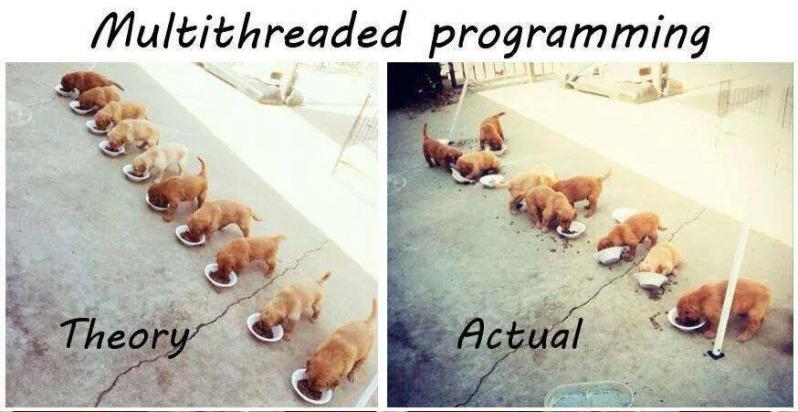
Instead of our classic view of a single point of execution within a program (i.e., a single PC where instructions are being fetched from and executed), a multi-threaded program has more than one point of execution (i.e., multiple PCs, each of which is being fetched and executed from).
More details
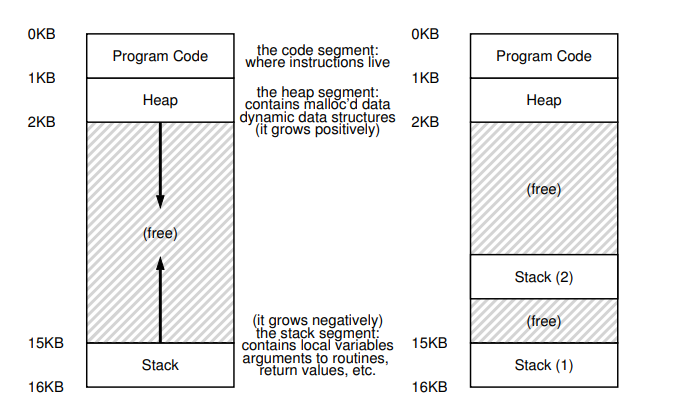
Perhaps another way to think of this is that each thread is very much like a separate process, except for one difference: they share the same address space and thus can access the same data.
Important Terms
- A critical section is a piece of code that accesses a shared resource, usually a variable or data structure.
- A race condition arises if multiple threads of execution enter the critical section at roughly the same time
- An indeterminate program consists of one or more race conditions; the output of the program varies from run to run, depending on which threads ran when.
- mutual exclusion guarantees that only a single thread ever enters a critical section, thus avoiding races, and resulting in deterministic program outputs.
Code Example
We assume that the process never terminates in the pre-protocol, critical section, and post-protocol areas. A process can terminate abnormally in the remainder section. If a process dies in the remainder section, it should not affect other processes.
for(;;){
        /*pre-protocol*/
        /*critical section*/
        /*post-protocol*/
        /*remainder*/
}
Context Switch
- Threads will context switch just like processes
- Instead of a process control block (PCB) we have a thread control block (TCB)
- When switching between threads of the same process the address space remains the same!
Memory Layout
Why Use Threads?
- First reason: Parallelism 🚙🚙🚙
- The second reason: to avoid blocking program progress due to slow I/O
- Opening and reading 10 files all at once!
Why not just processes?
- Of course, in either of the cases mentioned above, you could use multiple processes instead of threads.
- Threads share an address space and thus make it easy to share data, and hence are a natural choice when constructing these types of programs
- Processes are a more sound choice for logically separate tasks where little sharing of data structures in memory is needed.
Example
1 #include <stdio.h>
2 #include <assert.h>
3 #include <pthread.h>
4 #include "common.h"
5 #include "common_threads.h"
6
7 void *mythread(void *arg) {
8       printf("%s\n", (char *) arg);
9       return NULL;
10 }
11
12 int
13 main(int argc, char *argv[]) {
14      pthread_t p1, p2;
15      int rc;
16      printf("main: begin\n");
17      Pthread_create(&p1, NULL, mythread, "A");
18      Pthread_create(&p2, NULL, mythread, "B");
19      // join waits for the threads to finish
20      Pthread_join(p1, NULL);
21      Pthread_join(p2, NULL);
22      printf("main: end\n");
23      return 0;
24 }
Instruction Interleaving
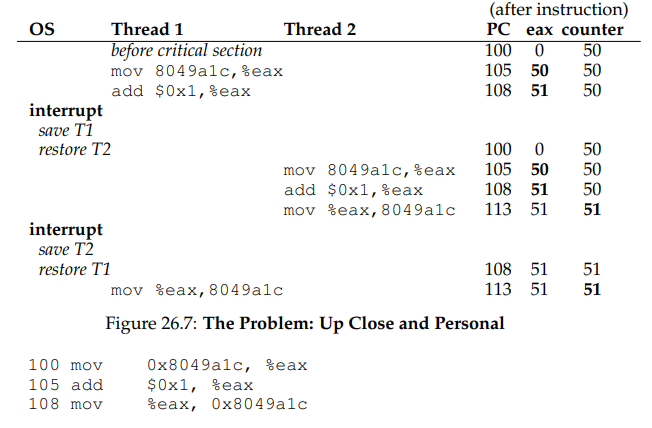
We don’t control the scheduler! ⚠️
counter = counter + 1;

// Assembly
mov 0x8049a1c, %eax
add $0x1, %eax
mov %eax, 0x8049a1c
Atomicity
One way to solve this problem would be to have more powerful instructions that, in a single step, did exactly whatever we needed done and thus removed the possibility of an untimely interrupt.
//pretend atomic add instruction!
memory-add 0x8049a1c, $0x1

//Performs all three instructions without interruption!
mov 0x8049a1c, %eax
add $0x1, %eax
mov %eax, 0x8049a1c
Synchronization Primitives
- Need to build primitives that allow us to do atomic operations
- Locks 🔒
- Need to build primitives that allow us to wait for action to be complete
- Condition Variables
- Need to build more powerful primitives
- Semaphores
Why in OS Class?
Why are we studying this in OS class? “History” is the one-word answer; the OS was the first concurrent program, and many techniques were created for use within the OS. Later, with multi-threaded processes, application programmers also had to consider such things.