Scheduling
First In, First Out (FIFO)
- Most basic algorithm
- Also known as First Come, First Served (FCFS)
- Simple to implement
- Not a great performer
Perfect
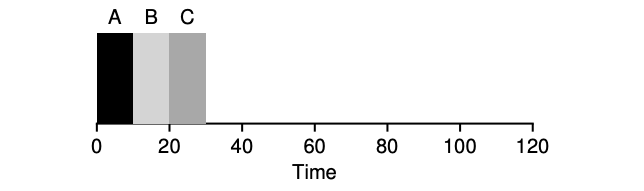
T_turnaround = (10 + 20 + 30) / 3 = 20Bad Performance
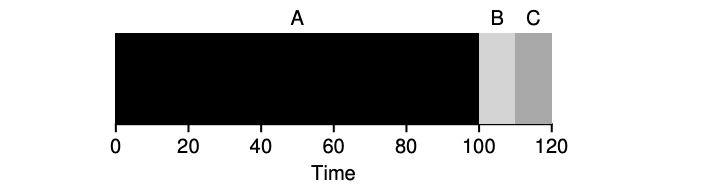
T_turnaround = (100 + 110 + 120) / 3 = 110Shortest Job First (SJF)
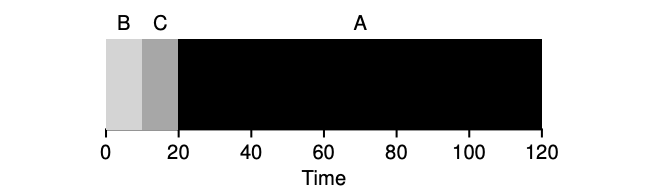
T_turnaround = (10 + 20 + 120) / 3 = 50Round Robin
The basic idea is simple: instead of running jobs to completion, RR runs a job for a time slice (sometimes called a scheduling quantum) and then switches to the next job in the run queue.
Turnaround Time vs. Response Time
These two metrics often pull in opposite directions:
- Turnaround time = completion time - arrival time. Optimized by running the shortest jobs first and letting each one finish (favors SJF/STCF).
- Response time = first run time - arrival time. Optimized by frequently switching between jobs (favors Round Robin).
Round Robin is excellent for response time but terrible for turnaround time: every job takes longer to finish because it keeps getting interrupted. There is no single "best" scheduler. The right choice depends on the workload and what the system is optimizing for.
Priority Inversion
A subtle hazard in priority-based schedulers: a high-priority thread can be blocked waiting for a resource held by a low-priority thread, while a medium-priority thread runs instead, indefinitely preventing the low-priority thread from releasing the resource. This is called priority inversion. The classic fix is priority inheritance: the low-priority thread temporarily inherits the high-priority thread's priority until it releases the resource. The Mars Pathfinder mission (1997) suffered a real-world priority inversion bug that caused repeated system resets.
Advanced Algorithms
The algorithms above are building blocks. Real operating systems use more sophisticated approaches:
- Multi-Level Feedback Queue (MLFQ): Multiple queues with different priorities and time quanta. Jobs that use their full quantum get demoted; short, interactive jobs stay at high priority. Approximates SJF without knowing job lengths in advance.
- Completely Fair Scheduler (CFS): The default Linux scheduler from 2.6.23 (2007) until 6.6 (2023). Tracks each process's "virtual runtime" using a red-black tree and always runs the process with the least virtual runtime. Achieves fairness across processes with different priorities (nice values).
- Earliest Eligible Virtual Deadline First (EEVDF): The default Linux scheduler since 6.6. It keeps the virtual runtime idea from CFS, but it also gives each task a virtual deadline, so a task that asks for short time slices (like an interactive program) gets to run sooner.
- Multiprocessor Scheduling: Adds the challenge of cache affinity (keep a thread on the same CPU to reuse warm caches) and load balancing across cores. Single-queue vs. per-CPU-queue designs make different trade-offs between simplicity and contention.