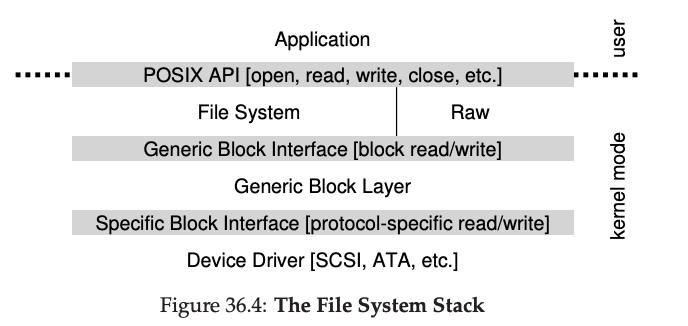
I/O Devices
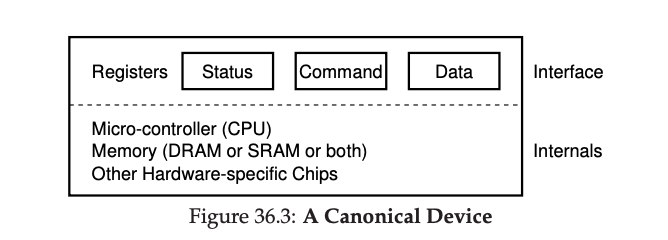
Introduction
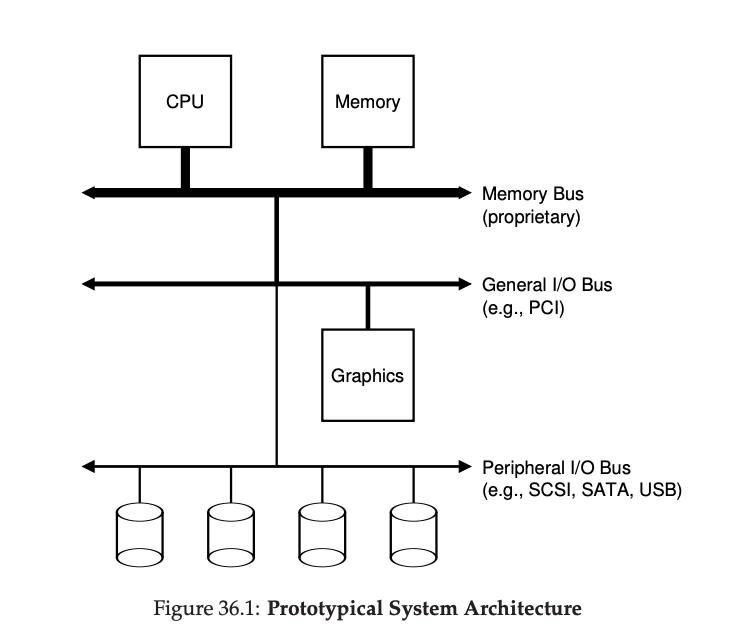
Modern System (Intel)
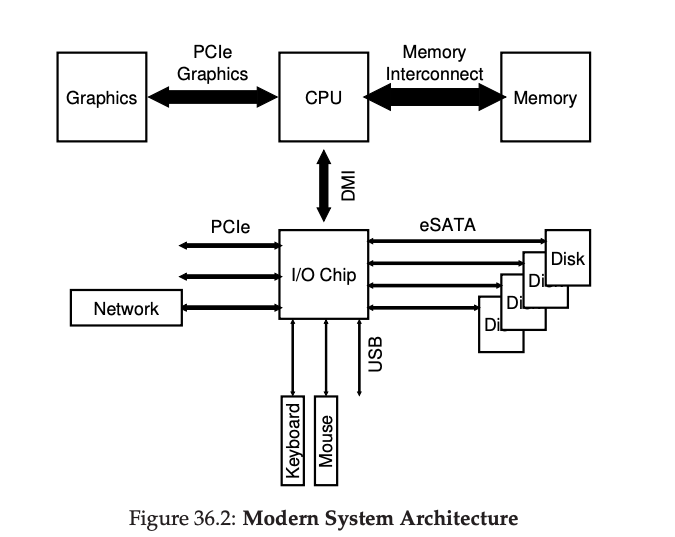
A Canonical Device
Protocols
- Polling the device
- Interrupts
Polling
While (STATUS == BUSY)
; // wait until device is not busy
Write data to DATA register
Write command to COMMAND register
(starts the device and executes the command)
While (STATUS == BUSY)
; // wait until device is done with your request
- Issues with this approach?
Interrupts
- Instead of polling the device repeatedly, the OS can issue a request, put the calling process to sleep, and context switch to another task
- When the device is finally finished with the operation, it will raise a hardware interrupt, causing the CPU to jump into the OS at a predetermined interrupt service routine (ISR) or more simply an interrupt handler.
Example


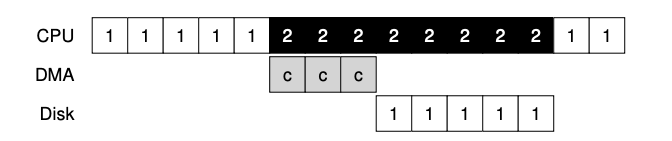
DMA
Methods Of Device Interaction
Explicit I/O instructions - These instructions specify a way for the OS to send data to specific device registers and thus allow the construction of the protocols described above.
Memory mapped I/O. With this approach, the hardware makes device registers available as if they were memory locations. To access a particular register, the OS issues a load (to read) or store (to write) the address; the hardware then routes the load/store to the device instead of main memory.
Fitting Into The OS: The Device Driver