Concurrency Bugs
Non-Deadlock Bugs
Non-deadlock bugs make up a majority of concurrency bugs, according to Lu’s study. But what types of bugs are these? How do they arise? How can we fix them?
Atomicity-Violation Bugs
A check and a use that should happen together, with another thread running in between.
Thread 1::
if (thd->proc_info) {
    fputs(thd->proc_info, ...);
}

Thread 2::
thd->proc_info = NULL;
- How to fix this?
Order-Violation Bugs
One thread assumes another has already run, and nothing makes it wait. Both kinds of bug are races.
Thread 1::
void init() {
    mThread = PR_CreateThread(mMain, ...);
}

Thread 2::
void mMain(...) {
    mState = mThread->State;
}
Deadlock
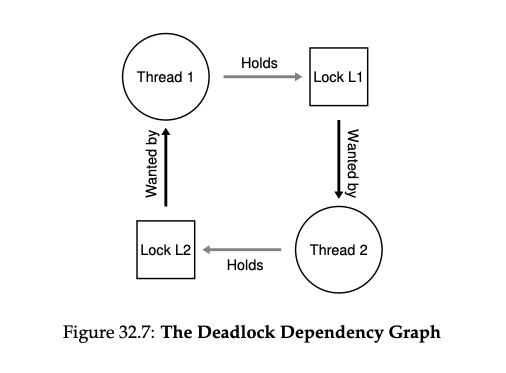
Thread 1:                   Thread 2:
pthread_mutex_lock(L1);     pthread_mutex_lock(L2);
pthread_mutex_lock(L2);     pthread_mutex_lock(L1);
Conditions for Deadlock
- Mutual exclusion: Threads claim exclusive control of resources that they require (e.g., a thread grabs a lock).
- Hold-and-wait: Threads hold resources allocated to them (e.g., locks that they have already acquired) while waiting for additional resources (e.g., locks that they wish to acquire).
- No preemption: Resources (e.g., locks) cannot be forcibly removed from threads that are holding them.
- Circular wait: There exists a circular chain of threads such that each thread holds one or more resources (e.g., locks) that are being requested by the next thread in the chain.
Prevention
- Circular Wait - total ordering or partial ordering
- Hold-and-wait - global lock
- try-lock
- lock-free data structures (HARD!)